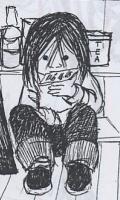
Cruddy: an Illustrated Novel
This is a placeholder for the review I will write after I talk about this with my book club (i.e. Celia), augmented with some quotations.
reviewdate:
Feb 12 2009
isn:
0-684-83846-x
This is a placeholder for the review I will write after I talk about this with my book club (i.e. Celia), augmented with some quotations.
My father gave me this book, a translated (from Yiddish) autobiography and supporting essays about a turn-of-the-century Jewish farm wife, saying that it was one of the best books he ever read. It didn't quite touch me in the same way it did my father, who has more sentiment for his immigrant parents than I do for the immigrant grandparents I never knew, though of course our family was urban, located in Newark, NJ.
Trial novel meets
screenplay. Young black man, called a
monster by the law.
I am happy to have this book to point to whenever anyone asks me, "But are people still making zines?" The answer, with about 100 zines published in the last year excerpted and another 75 or so listed as honorable mentions, is an emphatic "Yes!" I loved seeing the zines, reproduced as closely as possible to how they originally appeared, but even more, I was inspired by Katie Haegele and Cindy Crabb's loving introductions. And I gotta say the Zine Libraries Index Julie Turley and I contributed is also pretty hot.
I love zines. Dreaming them up, physically constructing them, and bringing them to the post office all snug in their packages makes me feel whole in a way not much else does. … The medium of zines reminds me of the point of the work: the deep and sincere need to be heard, the yearning for communion. I sign most of my zines "love, Katie" as though they're letters because they feel a lot like letters. I mean, I wouldn't bother saying something if I didn't think there was someone to say it to. … The connection people make with each other through writing and reading is as human as we get, and zinesters know this, they live it. I'm writing this now and you're reading it in another now, which means we're here together in a way; wherever we are, we're both crackling with the same kind of life. --Katie Haegele, Introduction, p.1
Zines were how we learned to exist outside ourselves when the world told us to disappear. …
It was the hand touching hand as the zine was passed between you. …
It was about creating real physical connection in the face of nothingness. It was folded well loved pages falling apart and holding you together, kept safe in your pocket as you rode the train under the bay from Oakland to San Francisco, and knowing that there was someone else out there, someone you met in passing for a second who had given you this gift who had secrets like your own. And that you weren't alone. –Cindy Crabb, Introduction, p.1-2.
It's hard not to acknowledge that zines are best for their immediate, ephemeral qualities. That feeling that you've found something truly unique and special, from a seemingly unlikely source. For these reasons, putting zines in a mass—produced book is seemingly contradictory. …
Every day we are told that print is dying, but as our co-worker Chris says, "If print is dead, it's another reason to like zombies." –Joe Biel, p.6
This is essentially a poor little rich girl story, about a plump, socially awkward half an orphan, half-Jewish teenager in NYC and Boston in the late 1940s. The book surprised me, as I was expecting a more hateable heroine. In fact, one of the things that saves her, is that she is not brilliant, not beautiful, and not particularly sensitive or insightful. She is just a troubled teenager, who happens to be worth a ton of dough but is basically emotionally isolated while having to navigate the death of one parent and realizing the other will never be there for her either.
It was obvious that Judy would never be idle until she was downed by old age or a terrible disease. And as for rich, she didn't have it in her. No matter how much money she had invested in AT&T or Eastman Kodak, no matter how large her bank balance, she thought poor. She didn't have the flair to throw away bread crusts and socks worn at the heels. She couldn't buy a ring for herself merely because she liked the look of the gem. She could never have owned thirty pairs of shoes, the way my mother did, nor spend $45 on a cotton dress to wear in the city in August when everyone was away. Judy thought in terms of saving, not spending, which I discovered was the big difference. Almost, in fact, as big as the difference between your German Jew and your Russian Jew. My mother was a spender, and she had such fun--oh she had an absolutely lovely time spending oodles of fresh, sticky bills tucked away in their Mark Cross wallet until she was ready to snap them out. p.205-206
Archiving Women was a one-day conference "bringing together scholars and archivists to examine feminist practices in the archive."
If I were a little more organized, I could share my notes, but unfortunately they're gone. Instead I'm going to bring up three different threads that for me characterized the event. They are preservation vs. privacy, the de-emphasis of the practitioner, and notable vs. common lives.
PS My presentation.
I catalog a lot of zines by writers who identify as queer--not gay, not HOMOSEXUAL, not LESBIAN, not BISEXUAL (though sometimes omnisexual or pansexual)--and I am at a loss for how to represent them in Library of Congressese. SEXUAL MINORITIES seems to be the best the folks at SACO have to offer, but I just have to wonder if persons of the queer persuasion are really happy with that. If the answer is no, what would you like the descriptor to be? I'm addressing this query primarily to queer folk and catalogers.
This is A.j. Michel's log of her year's reading (books, comics, and zines), listening, and television and movie watching. I've thought of trying to chronicle more than just my reading, but have been too daunted. A.j., who I believe is a card-carrying but non-practicing librarian, is geekarifically organized and precise, and she provides a fair use statement to justify her inclusion of the occasional zine excerpt.
I recommend this zine to anyone looking for things to read, listen to, and watch, but it's especially appropriate if you have a serious comics jones and like your science fiction okay. Since I'm seriously challenged when it comes to music, I can't be trusted to characterize her taste, but I think indie would cover it, though perhaps too broadly.
Much like WALL*E debating where to place the spork he collected (With forks? With spoons?*), deciding how to arrange this consumption log was fraught with struggle. Should it be arranged by type of media consumed or by date it was consumed? If by type, where do graphic novels go - books or comics? What about graphic novels that are collections of previously published comic issues? Is watching a movie on DVD the same as watching it in a movie theater? What about movies on broadcast television or cable? Are television episodes on DVD still television? --inside cover
*After some deliberation, WALL*E placed the spork between the individual containers holding the fork and spoon collections.
(You can tell it's not "chick lit" because the cover does not feature a disembodied female body part, and isn't a pink hue.) p.16-17